I decided to look at the trailer for Inception in order to see how they advertise their Thriller film.
The first thing that happens in the trailer is a CU of the spinning top, one of the most symbolic enigma codes in the entire film. This links in with the idea of it being important in the film. You then see the main character in the film standing next to a table and spinning it.
This trailer also makes use of a voiceover in order to give a brief idea of what the film is about. The first thing the character says is "what's the most resilient parasite?". This immediate rhetorical question intrigues the audience due to the fact they are intrigued and want to discover the answer.
Some official ident logos are then shown in order to see the makers behind the film. Because they are all very famous companies, the audience feel straight away that the film is going to be very good because of their successful history.
The music gets a lot more tense at this point in order to increase the suspense. There are then some CUs of people's faces. You can see they are looking at something as they are shocked but the audience isn't told what. This CU is used in order to make the audience want to know what it is the characters are looking at because you can see their reaction. The reason for their surprise is quickly revealed - a disorientating establishing shot of the world seeming to fold over itself. This makes the audience ask why this is happening - but this is not revealed in the trailer. In order to find out why, the audience has to watch the film.
After another CU, this time of some water rippling (suggesting that the ground is shaking) and an over-the-shoulder shot of a man looking out the window at an explosion (again, increasing the action and tension) there are some medium shots introducing some more of the characters before the voiceover says "which is why....." and the music builds up to a crescendo and goes quiet right at the same moment the screen snaps to black. The character says "I have to steal it" before the music begins again and there is an action shot of him with a gun. There is then a black screen saying that it was directed by the same person as The Dark Knight, again making the audience aware that there is a lot of experience behind this film and so making them sure that it is going to be good.
There are then some more exciting shots like explosions and more of that funny world-folding thing and this showcases to the audience how some of the special effects throughout this film are quite spectacular.
Throughout the trailer, the main character is in a suit and this is a typical thriller costume. However, his suit is quite a light grey colour (as opposed to the dark colours that thriller characters usually wear) and this is breaking a stereotype, making the film a lot more interesting to watch.
Additionally, although he appears to be a good character, you see him in this trailer pointing a gun at people and being part of an explosion. Therefore, it makes the audience wonder whether he is a 'good guy' or a 'bad buy' - again, another typical Thriller convention.
Overall, I think this is a really good trailer and it has made me consider whether we should break some stereotypes in our film in order to make it more interesting for the audience. One idea that I have is to, instead of using an old man like our target audience has expressed their interest for, to use a young person (possibly late teens, early 20s) because this would be unexpected to the audience and so would appear more exciting.
Sunday, 10 November 2013

Thursday, 7 November 2013
Target Audience Research
As part of our target audience research for our thriller film opening, we decided to go round our school and 'interview' different people of various age groups and gender to get a varied and better collection of answers and opinions, non-biased. We each took it intern to ask different people the same questions. We wanted to use the same questions otherwise we wouldn't get fair results - we wanted different answers for the same question as it would be easier to identify strengths and weakness for those questions and it would be easier to evaluate different opinions. We didn't want to use leading questions but instead use open answer questions so the 'interviewees' could gave a full independent personal answer. The questions were: do you watch thriller films?, what is your favourite narrative? (we had to sometimes describe to our 'interviewees' what a film narrative was and give examples), what is your biggest fear?, what is the scariest age for a villain?, what gender do you find scarier in a villain? and what is a scary location?. Although these are good questions which cover a range of aspects for a film, looking back at it, it seems that the questions may have been a bit horror-film-orientated. Thriller films aren't based around scaring and putting fear into the audience, instead emphasise mystery and leave the audience questioning. Evaluating the audience research video, I would say that maybe we should have used questions which were more thriller based such as: what is a mysterious location?, what do you find mysterious and eerie? and just simply - what gender is best for a villain? In addition, if the 'interviewees' had answered yes for the question "do you watch thriller films?" then they would have possibly understood questions which would have been more thriller based e.g. what gender is best for a villain in a thriller film? and get their views on what is best for a thriller film (considering that they watch thriller films). Like I said, they are still very good questions and we did get a lot of great answers and feedback from the people that we 'interviewed' which made our research much better. Also, because we asked teachers as well as students, we were able to get a mixed variety of answers from different age groups which made the research better as well. Although, sometimes some of the students we interviewed didn't actually give an answer for some of the questions due to maybe the other 'interviewee' talking over them or they literally didn't have an answer. We still got a great bunch of answers, and the gathering of our target audience research was a lot of fun! The video of our target audience research can be seen below.
Target Audience Research
As part of our audience research, we interviewed various people in our school to see what they liked in our Thriller film. As opposed to targeting a certain age group, we simply asked the question 'do you enjoy Thriller films' - this meant that we were able to get a further insight also into which age group Thriller films are particularly popular with. Take a look at the video below.
The concept which stood out for me in this video is the idea of not knowing who the 'good guy' and 'bad guy' is until the end of the film. This is a typical thriller convention, and something which I think we would be able to implement particularly well into our film. Because our final idea is based around somebody coming into someone else's house who appears to be good, I think it would work really well.
Something else which is particularly evident from this research is the fact that people seem to find elderly people the scariest villain. Therefore, as opposed to using myself as the villain, I am really keen to use someone a lot older than me in order to appeal to our target audience.
Additionally, I have also analysed the feedback we received from our Thriller survey which we posted online a few weeks ago. We had an array of answers, but the most popular answer for "what makes a Thriller film scary?" was the idea of something happening to someone that could happen to anyone: something which is realistic and therefore will scare the audience for longer. People also liked the idea of cliffhangers and never finding out what happens, as well as the element of mystery.
Similarly to the Thriller interview video, 42% of survey respondents said seeing an elderly person (particularly a man) as being the scariest thriller villain. This has been such a popular response throughout our audience research and we would be mad to not listen to them!
70% of respondents also explained that they would prefer for the victim to be alone when they are killed, and so we have adapted our narrative to make this the case. They will now be isolated in a house at the time of their murder.
We have received a lot of really useful feedback from our research and now we have made changes because of the responses we have received, I am beginning to get really excited for the initial filming in a week or so!

Wednesday, 6 November 2013
Saw (Analysis)
Film: Saw
Directed by: James Wan
Starring: Tobin Bell, Cary Elwes, Leigh Whannell, Danny Glover, Michael Emerson
Released: 2004
Elements of Mise en Scene, Editing, Camerawork/Cinematography and Sound
The majority of the camerawork in Saw is steadicam. This is significantly used in the bathroom scenes with Adam and Doctor Gordon. This is so we get a hands-on gritty experience with them in bathroom and gives the film a sense of realism and it makes the audience feel like they’re up close and personal with Adam and Doctor Gordon in the bathroom because we can then see their every move and their emotions. This also presents the film in an eerie, uncertain sense because the camerawork is very loose, unguided and un-artificial. This specific technique is the most effective for building tension.
There is also some uses of close-up shots on the characters, again, specifically on Adam and Doctor Gordon in the bathroom. One example of this is when Doctor Gordon is on the phone to his wife who is being held captive and as she is tormented, Doctor Gordon becomes very upset and starts to breakdown. The close up shot on Doctor Gordon’s face helps capture his emotions up-front and personal so the audience can really get an idea of the situation and how badly Doctor Gordon is feeling. This allows the audience to feel sympathetic for him.
Another use of steadicam in Saw is when Alison Gordon (Doctor Gordon’s wife) breaks free from captivity, and tries to overpower ‘Zip’. As she does this, there is a lot of confrontation between the two characters. Steadicam is used in this scene to accomplish the fast-paced action of the scene and follows Alision as she tries to escape. This particular use of steadicam keeps up with the pace of the action and emphasises the pace and speed, also making the audience uncertain but intrigued because the camerawork is very impulsive and uncontrolled and the audience then have to focus more on what is going on.
The mise en scene in Saw is very important and plays a vital role. Right at the beginning of the film, their is very dark lighting being used as Adam awakes in the bathtub and and starts to stumble around and find out where he is. He is very confused at this point and because of the dark, low-key lighting, the audience are also very confused as well because they are in the same position as Adam. Adam has woken up in the darkness and the audience have started watching the film with the film beginning with darkness. It also emphasises the sense of mystery and intrigues the audience to the film because they want to discover where Adam has woken up.
When the lights turn on, we are immediately exposed to the filth, dirty set of the bathroom. The bathroom is absolutely filthy with broken mirrors, broken tiles, dirty and mould riddling up the walls, rusty toilet and bathtub and disgusting pipework around the bathroom. This helps show the bathroom’s age and misusage and gives background and mystery to the setting - has the bathroom been used for torture and captivity before? It also makes the film more gritty and makes it more realistic.
Throughout the course of the film, there is an obvious transformation being done to Doctor Gordon. Every time we see him in the bathroom, his face gets more pale and starts turning white, ultimately making him look ghost-like. This is showing Doctor Gordon’s deterioration and possibly saying that the bathroom which he is trapped in is slowly killing him and draining him, causing him to break-down, resulting in him going crazy and cutting his foot off to escape. The white make-up on Doctor Gordon (getting more pale throughout the film) gives the character realism and a sense of believability for the audience as they watch him slowly become stricken.
An example of digitally enhanced sound is when we hear a striking electric and buzzing sound when Adam gets electrocuted. The sound is ‘digitally enhanced’ and extremely emphasised to make the audience hear how painful it is for Adam as he screams in agony, as his body shakes to the reaction of the electricity and to also make the sound and action more forceful and striking.
Diegetic sound plays a big role in Saw, especially in the bathroom scenes. In these particular scenes, there is good use of diegetic sound to make the room more realistic and tense. Realistic, because all the sound that are heard are natural and belong to that bathroom and tense, because there isn’t any additional music/narration on top of the scenes, making them more quiet and eerie. Non-diegetic sound is not needed for these scenes because the quiet, natural sounds of the empty, misuses bathroom are enough to grip the audience and make them intrigued to the natural dialogue of Adam and Doctor Gordon.
Non-diegetic sound is used at some occasions in Saw. One example is at the end of the film, when Adam discovers the audio tape on Zip, and plays it, there is the Saw ‘theme tune’ (soundtrack) being played over the scene as he listens to the audio tape. This has been added to make the ending of the film more shocking and tense as we slowly reach the conclusion. The music is also a crescendo and gradually becomes louder. This makes the ending of the film more tense and gripping for the audience as they become glued to the screen. Right before the end credits appear, the music reaches it’s ultimatum and suddenly stops as Jigsaw closes the door on Adam, leaving him trapped in the bathroom to rot and die. When the music does suddenly stop, the only sound we hear is Adam’s screams (diegetic sound) as the credits appear. This has been done to show that even though the film is over and the credits are rolling, Adam is still left trapped in the bathroom and the audience shouldn’t just forget about him, which is why his merciful screams play over the ending credits, leaving the audience in a total shock.
How does Saw fit the Thriller genre?
I would say that Saw is more of a psychological thriller. This is because the danger of the protagonists (hard to pinpoint, but Adam and Doctor gordon are the main ones...) is heavily emphasised. This is clearly obvious that their danger is a strong element of the film because they have woken up in this misused bathroom without any indication of where they are specifically and how they got there (although we do find out later on in the film). This is also why it is more psychological because the two protagonists are uncertain of what is actually going on so their emotions take over them and conflict starts to erupt between them and ultimately drive them both crazy(leading Doctor Gordon to cut off his own foot to escape). In addition, psychological thrillers make the characters solve a mystery and Saw is one big mystery. Why are they in there? Who put them in there? - and throughout the curse of the film, they discover more clues and facts that make them realise why they are actually there...
Tuesday, 5 November 2013
Mise-en-Scene
Mise-en-Scene is used throughout thriller films, it includes: costume, lighting, hair and makeup, props and setting. Here are the common ones used for thriller films.
Costume:
Many of the protagonists in thriller films are seen to be dressed in black, this shows that they are dark and dangerous characters and that they're no necessarily all good even though they are seen to be the 'good guy'.
The male protagonists are usually seen wearing suits, this goes back to when thriller films were first made and mainly based on police detectives solving murder mysteries, here they were always dressed smart as part of their job. This has become a convention because it makes the protagonist look like and important person, many of the other characters are also dressed in suits as well (usually the antagonist) to show how they are also important.

Stereotypically women in thrillers are dress in elegant dresses which depict them as sexy and an objects of lust.This helps show the danger of the femme fatale character as they are seen to be just innocent and not a danger whereas they're always the major downfall of the male protagonist.

Hair and makeup:
This is usually done to fit in with the costume the character is wearing, like for example women will have their makeup done to match whatever colour their dress is.
However in some cases makeup is used to make a character look scary and menacing. They use this in The Dark Knight by giving the Joker clown makeup, this scares the audience because many people are afraid of clowns so this draws on the phobia. The makeup also partly hides the Jokers identity and his scars which create a mystery about him and make him a more ominous character.
Lighting:
Dark and ominous lighting is used often throughout thrillers as it creates a mysterious and dangerous vibe to the setting as the audience can't clearly see what is going on and it also cast the characters in dark lights making them too look mysterious and dangerous.

Props:
Weapons:
Common weapons used are guns, knives, explosives, etc. These all help create tension and danger throughout, and therefore keep the audience on the edge.
Other:
Props like briefcases are also used, these create a mystery as the audience want to know what's in them and why they are being kept so secretive. These can also be used as a good red-herring to confuse and mislead the audience.
briefcases: mysterious
Setting:
Many Thriller films are set in ominous and conspicuous places, although some are set in more common places that the audience would know.
Action based thrillers are usually set in big cities as narrative events like heists and hostage situations can take place. They're done here as it makes the scene more tense and dangerous as more peoples lives can be at risk. People can also relate to this therefore making them feel a sense of danger as it could happen to them.
Many of the protagonists in thriller films are seen to be dressed in black, this shows that they are dark and dangerous characters and that they're no necessarily all good even though they are seen to be the 'good guy'.
The male protagonists are usually seen wearing suits, this goes back to when thriller films were first made and mainly based on police detectives solving murder mysteries, here they were always dressed smart as part of their job. This has become a convention because it makes the protagonist look like and important person, many of the other characters are also dressed in suits as well (usually the antagonist) to show how they are also important.
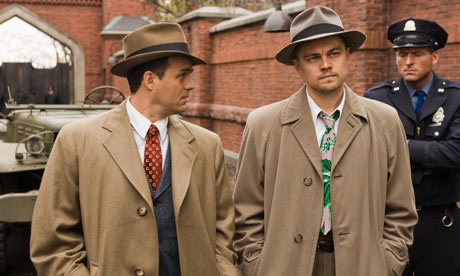
For eg. in Shutter Island Teddy and his assistant are police detectives and the main protagonists and are both seen dressed smart in suits.
Stereotypically women in thrillers are dress in elegant dresses which depict them as sexy and an objects of lust.This helps show the danger of the femme fatale character as they are seen to be just innocent and not a danger whereas they're always the major downfall of the male protagonist.

For eg. The character Vesper in Casino Royale is the femme fatale and here is seen in an elegant and sexy dress, showing her to be lustrous and an object of desire not danger.
Hair and makeup:
This is usually done to fit in with the costume the character is wearing, like for example women will have their makeup done to match whatever colour their dress is.
However in some cases makeup is used to make a character look scary and menacing. They use this in The Dark Knight by giving the Joker clown makeup, this scares the audience because many people are afraid of clowns so this draws on the phobia. The makeup also partly hides the Jokers identity and his scars which create a mystery about him and make him a more ominous character.
Lighting:
Dark and ominous lighting is used often throughout thrillers as it creates a mysterious and dangerous vibe to the setting as the audience can't clearly see what is going on and it also cast the characters in dark lights making them too look mysterious and dangerous.

For eg. In the opening scene of Casino Royale part of it is set in an office, this place is shown in dark lighting to help show the mystery about the setting and the characters.
Props:
Weapons:
Common weapons used are guns, knives, explosives, etc. These all help create tension and danger throughout, and therefore keep the audience on the edge.
Other:
Props like briefcases are also used, these create a mystery as the audience want to know what's in them and why they are being kept so secretive. These can also be used as a good red-herring to confuse and mislead the audience.
briefcases: mysterious
Setting:
Many Thriller films are set in ominous and conspicuous places, although some are set in more common places that the audience would know.
Action based thrillers are usually set in big cities as narrative events like heists and hostage situations can take place. They're done here as it makes the scene more tense and dangerous as more peoples lives can be at risk. People can also relate to this therefore making them feel a sense of danger as it could happen to them.
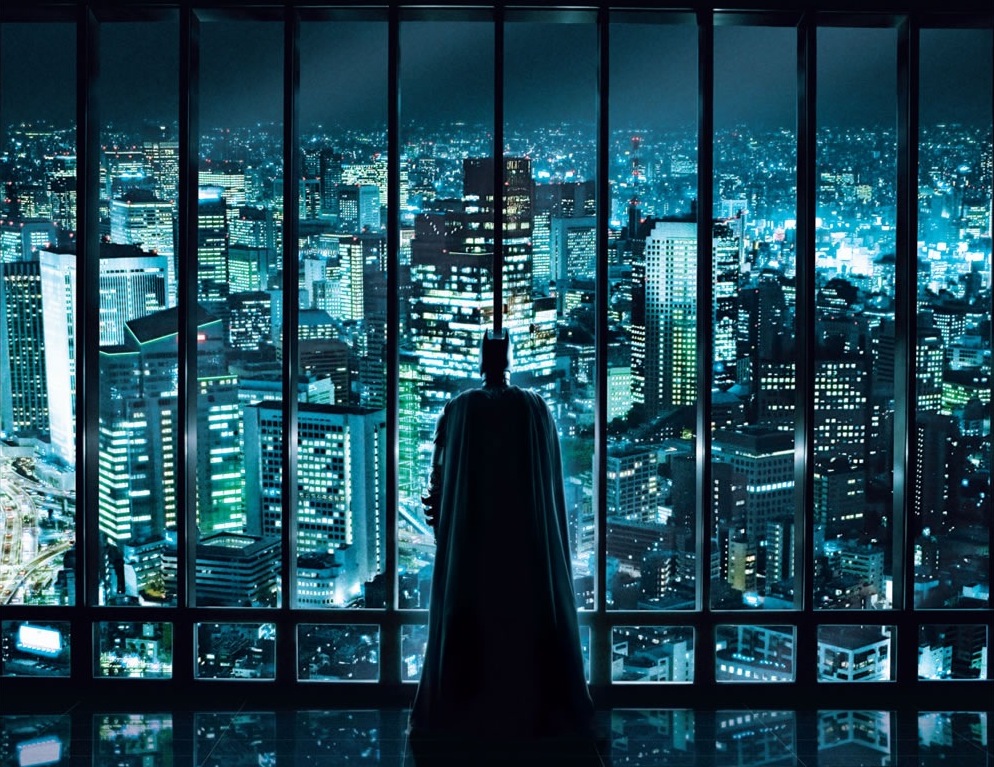 |
| For eg. Gotham Ciy - Batman Begin, The Dark Knight, The Dark Knight Rises |
In psychological based thrillers more remote and eerie locations are used. This is to create a tense atmosphere making the audience feel perhaps apprehensive and see there's danger in the location. Scary atmospheres also help thrill people, fitting in with the main aim of the genre.
 |
| For eg. Shutter Island, set on a remote and desolate island away from everything |
Subscribe to:
Posts (Atom)